
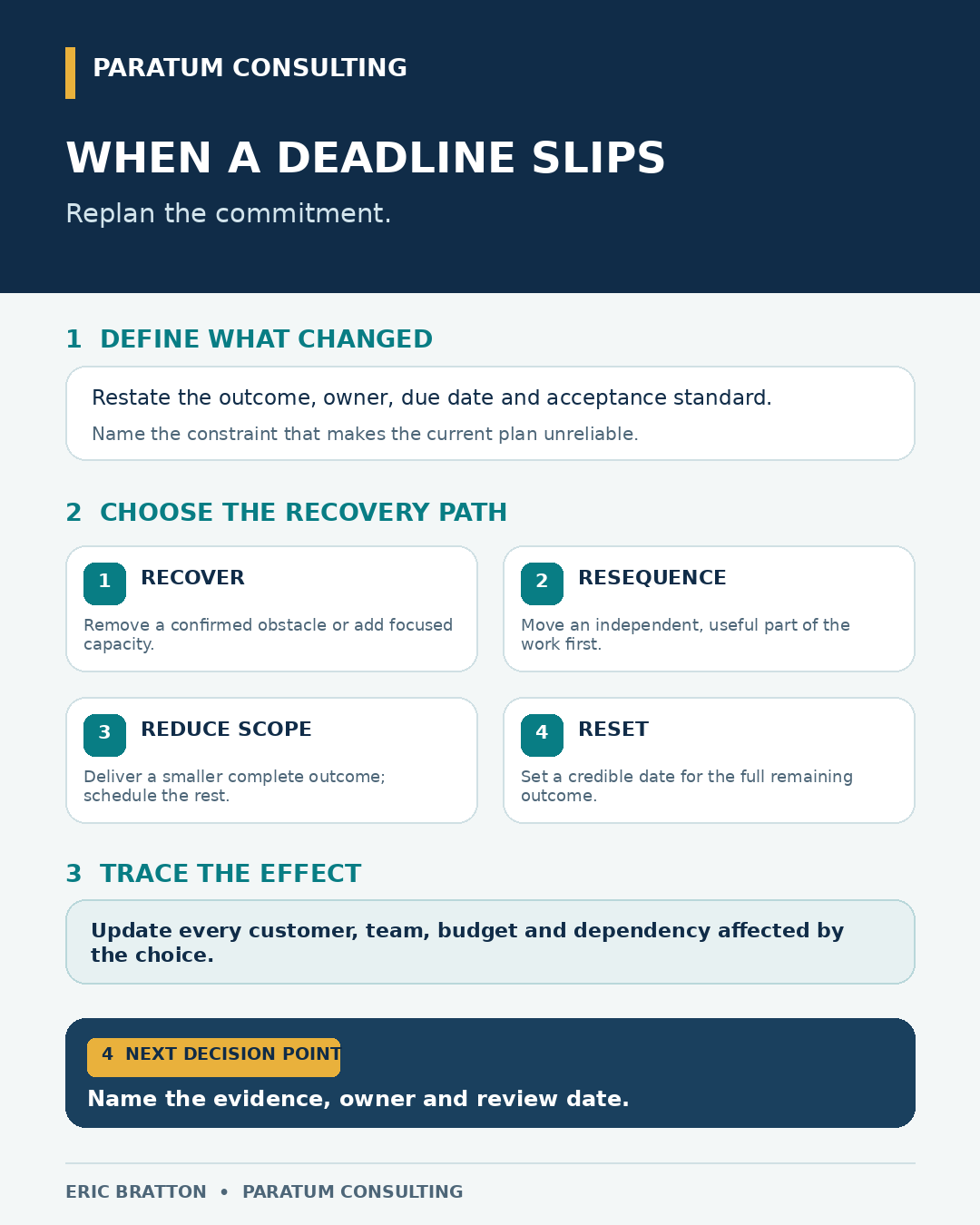
A missed milestone often produces a familiar response: ask for another update, add a meeting, or tell the team to move faster. Those actions may increase attention, but they do not resolve the decision created by the delay.
Once a commitment is at risk, the operating plan has changed. The remaining work, available time, dependencies, and customer promises may no longer fit together. Leadership must decide which part of the plan will move and make that choice visible to everyone whose work depends on it.
A short recovery review can turn a vague status problem into a specific business decision.
1. Restate the commitment in operational terms
Begin with the outcome, owner, due date, and acceptance standard. “The project is behind” is too broad. A useful statement sounds more like: “The revised customer onboarding process must be ready for five pilot accounts by November 15, with training completed and exception support available.”
Then identify what is actually at risk. Is the result incomplete, untested, waiting for a decision, or blocked by another team? A percentage-complete estimate can hide the part that matters most. Review the unfinished deliverables and the evidence required to call each one complete.
Keep the original promise visible. Quietly redefining completion makes the report look better while transferring the risk to the customer, employee, or downstream team.
2. Name the constraint that changed the plan
Ask what prevents the current commitment from being met with the resources and sequence already approved. The answer should describe a constraint that can guide a decision: specialist availability, missing customer input, an unresolved policy choice, a system dependency, or additional work discovered during testing.
Separate the immediate constraint from a general explanation. “Competing priorities” does not show which commitment consumed the time or who can change the trade-off. “The same analyst is required for the regulatory review and the launch test during the same two weeks” gives leadership a choice to make.
Confirm the constraint with the people doing the work. Pressure to recover from an incorrect diagnosis can create more activity without improving the date.
3. Choose the recovery path deliberately
There are four common responses. Select one, or state clearly how a combination will work:
| Recovery path | Decision to make | Evidence to require |
|---|---|---|
| Recover | Add focused capacity or remove a confirmed obstacle while keeping the outcome and date. | A credible work plan showing how the constraint will be relieved. |
| Resequence | Change the order so an independent, useful part can proceed first. | Clear dependencies and confirmation that the new sequence does not create hidden rework. |
| Reduce scope | Deliver a smaller complete outcome by the existing date and schedule the remainder. | Explicit inclusions, exclusions, and an acceptance standard for the smaller release. |
| Reset | Change the date because the full outcome cannot be delivered responsibly within the current plan. | A revised date based on the remaining work, constraints, and decision lead times. |
“Work harder” is not a recovery path unless the team can identify a limited effort, its duration, and the effect on other commitments. Sustained overtime can move risk into quality, retention, or the next project.
4. Trace every promise affected by the decision
A recovery choice can protect one milestone while quietly breaking another. Before confirming it, list who depends on the original date, scope, people, or budget. Include customers, operations, sales, finance, vendors, and other project owners where relevant.
For an illustrative example, a service business preparing a new client portal may decide to launch account access and document exchange first, while moving automated reporting to a second release. The smaller first release needs its own acceptance standard, customer communication, support plan, and date for the deferred capability. Otherwise “reduced scope” becomes an ambiguous promise that each group interprets differently.
Name who will update each affected commitment and by when. The recovery plan is incomplete until downstream owners know what changed and can revise their own work.
5. Set the next decision point
Define the evidence that will show whether the recovery path is working. That may be completion of a blocked review, a successful test using representative cases, or confirmation that a required resource is available. Assign one owner and a date to review that evidence.
Use the review to decide whether to continue the plan, change paths, or escalate a remaining trade-off. Avoid turning the new date into another waiting period filled with status reports. The purpose of the checkpoint is to make the next decision while there is still room to act.
When a deadline slips, accountability means more than identifying who is late. It means making the new trade-off explicit, protecting the commitments that still matter, and giving the team a plan that can be executed. Start with one at-risk milestone: restate the promise, name the constraint, choose the recovery path, and trace every promise the choice will change.
Original management perspective. Examples are illustrative and do not represent client results or guaranteed outcomes.