
A growing backlog can make the case for another hire feel obvious. More people may be exactly what the business needs. But a backlog combines several kinds of work: customer demand, repeat work caused by errors, delays caused by unclear decisions, and tasks that no longer serve the business. Hiring against the total can add capacity while preserving the causes of the load.
The better question is not simply, “How busy is the team?” It is, “Which work should this team still be doing after we improve the way it operates?” A short capacity audit can help answer it without turning every hiring decision into a months-long study.
1. Define the unit of work and the service promise
Pick one workflow under pressure: proposals, service requests, month-end reporting, order changes, or another repeatable unit. State what a completed unit means and the service level the business intends to deliver. Count work arriving, work completed, and work waiting over a representative period. Record unusual events, such as a seasonal surge or a one-time project, so they are not mistaken for permanent demand.
This is a starting picture, not a productivity verdict. A team can close many requests while a smaller number of complex cases continues to age. Look at a few actual cases alongside the totals.
2. Sort the load before solving it
Take a sample of recent work and ask where the time went. The useful categories are:
| Type of load | Question to ask | Likely response |
|---|---|---|
| Necessary demand | Would we still choose to do this work if the process ran well? | Plan enough capacity to meet the promise. |
| Avoidable repeat work | Did an earlier error, missing detail, or unclear promise create another cycle? | Fix the cause and check whether repeat work falls. |
| Process friction | Is necessary work waiting on a handoff, approval, search, or duplicate entry? | Simplify the path or clarify authority. |
| Low-value legacy work | Would anyone make a different decision if this task stopped? | Stop it or reduce its frequency deliberately. |
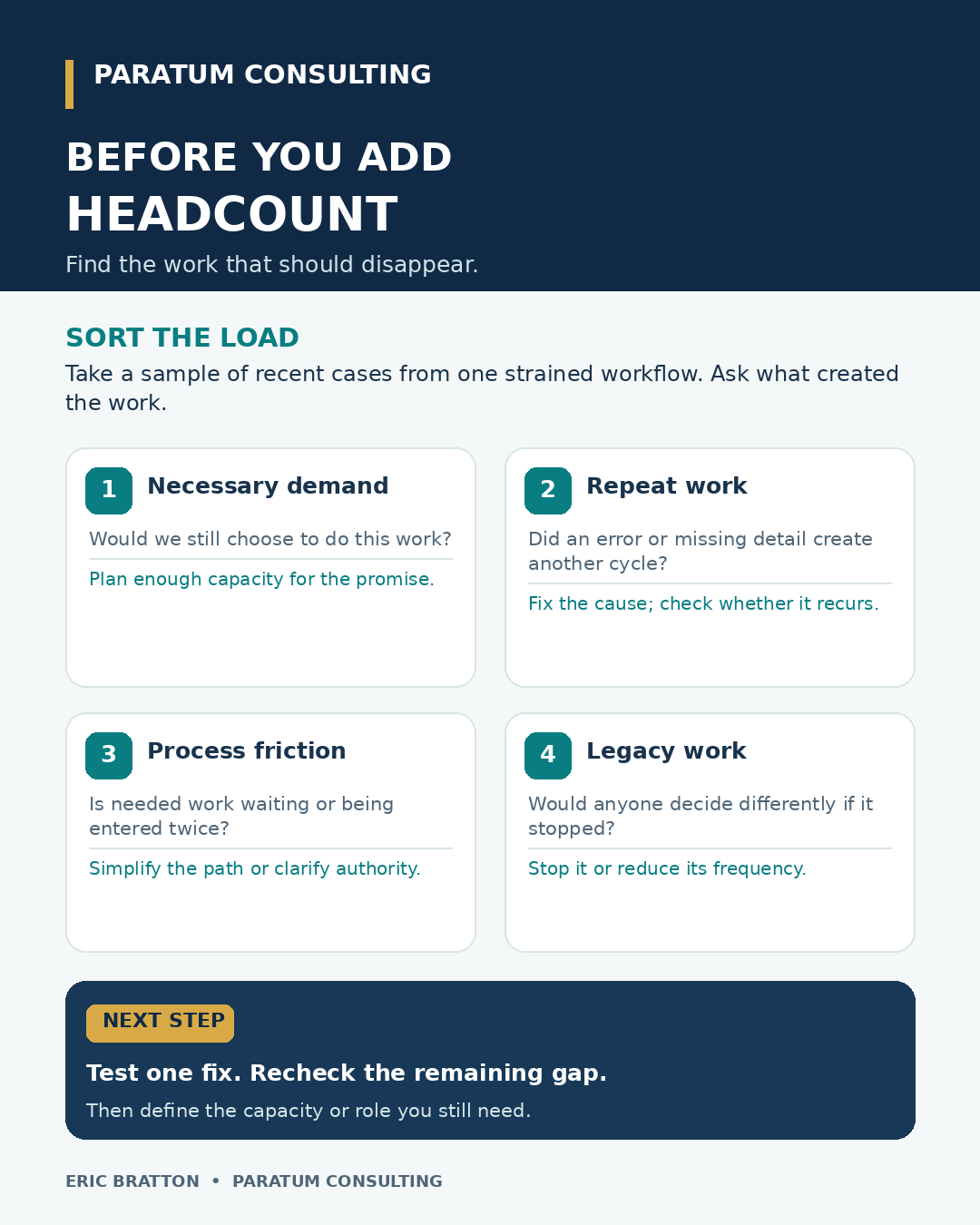
The categories are a diagnostic aid, not an accounting standard. One request may contain more than one kind of load. Have the people doing the work explain the case before assigning a label.
3. Run one small redesign test
Suppose a consulting team wants a new coordinator because proposal revisions are piling up. A case review shows that many revisions begin with missing scope information. For two weeks, the team could use a short intake checklist and name who can resolve scope questions before drafting starts. The test is whether fewer proposals return for clarification while response time and proposal quality remain acceptable. If it helps, keep the change. If it adds delay without reducing rework, revise or drop it.
Choose one cause you can change, one owner, and a date to decide. Avoid announcing a broad efficiency program on the strength of a handful of cases.
4. Make the capacity decision on the remaining work
After the test, review the backlog, service reliability, overtime or overload, and the quality of completed work. Ask whether demand still exceeds sustainable capacity once avoidable work has been reduced. If it does, define the role against the remaining work: which decisions, skills, and coverage will the new person provide? If the constraint is specialist review, adding general administrative capacity may have limited effect. If demand is temporary, a permanent role may be the wrong shape of capacity.
The goal is not to prove that a hire is unnecessary. It is to give a necessary hire a clear job and to avoid asking a new person to absorb a broken process. Leaders can start this week with one strained workflow, ten recent cases, and a conversation with the team about what created the load. The cases will usually make the next question more useful than the backlog total alone.
Original management perspective. The consulting example is illustrative, not a client result or a guaranteed outcome.